What Is Wear-Molding? How Your Insoles Adapt to Your Feet Over Time
If your new insoles felt a little different on day one than they do now, that's not your imagination — it's wear-molding, a process that happens to every insole you...
Read moreWe're proud to be a top-rated store!



Pedag Holiday Orthotic Arch Support Insole


Pedag Lady 3/4 Leather Insoles - Tan


Arch Angels Children's Comfort Insoles


PowerStep Pinnacle Junior 3/4-Length Insoles


Birkenstock Birko Flex Arch Support Insoles


Birkenstock Children's Birko Balance Arch Support Insoles


PowerStep Signature Dress Orthotics 3/4-Length


Vionic Slimfit 3/4-Length Insoles


Birkenstock BirkoClassic Arch Support Insoles


Sorbothane 3/4-Ultra PLUS Stability Insoles
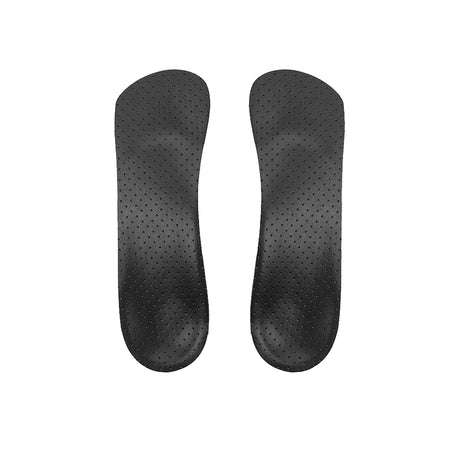

DoctorInsole HighStep Orthotic Insoles for Women


Birkenstock Birko-Tex Lined 3/4-Length Air Cushion Insoles
A 3/4-length insole is designed to provide arch support, heel cushioning, and midfoot structure without extending into the toe box of the shoe. It sits from the heel to roughly the metatarsal heads, stopping before the forefoot. This makes it the right choice for footwear where a full-length insole either won't fit, would change the fit at the toes, or would add unwanted volume to a shoe that already fits well. Dress shoes, heels, cleats, narrow athletic shoes, and footwear without removable insoles are all natural homes for the 3/4-length format.
The most important benefit of a 3/4-length insole is its compatibility with footwear that doesn't have the volume to accommodate a full-length design. Dress shoes, heels, tight-fitting cleats, and low-cut athletic shoes all fit this profile. By stopping before the toe box, the 3/4-length insole avoids the volume and fit issues that make full-length insoles impractical in many shoe types. For people who want consistent foot support across a range of footwear, a 3/4-length insole covers the shoes a full-length design cannot.
Many shoes, particularly dress shoes and lower-end casual footwear, don't have removable factory insoles. A full-length insole placed on top of a glued-in factory liner often causes the forefoot to sit too high or the shoe to feel uncomfortably tight. A 3/4-length insole avoids this by stopping before the densest part of the toe box, adding support and cushioning in the arch and heel where it's most needed without fighting for space in the narrowest part of the shoe.
For footwear where toe box fit is critical, such as performance athletic shoes sized tightly or dress shoes fitted to precise measurements, a 3/4-length insole preserves the existing forefoot fit entirely. The insole's benefits are delivered from the heel through the arch, where support matters most for most foot conditions, without touching the forefoot fit the shoe was purchased for.
A 3/4-length insole provides the same arch support, heel cushioning, and midfoot structure as a full-length design of equivalent quality. For conditions that don't specifically require forefoot cushioning, the 3/4-length format delivers everything a full-length insole provides in a more versatile form factor. For flat feet, overpronation, plantar fasciitis, Achilles tendinitis, and most general foot fatigue conditions, a 3/4-length insole is fully equivalent to full-length support.
For most foot conditions, yes. The arch and heel are where support matters most for conditions like plantar fasciitis, flat feet, and overpronation, and a 3/4-length insole delivers full support in these zones. The only conditions where full-length support provides a meaningful advantage are those requiring specific forefoot cushioning or metatarsal support, such as metatarsalgia, Morton's neuroma, or ball-of-foot pain. For everything else, a 3/4-length insole in the right support level and cushioning is fully equivalent to a full-length design.
Yes. A 3/4-length insole works well in running shoes, training shoes, and most athletic footwear where the full-length factory insole is removable. Removing the factory insole and replacing it with a 3/4-length aftermarket design is a common approach for athletes who want the support features of a quality insole without the forefoot thickness that a full-length design adds. The factory insole's forefoot section can sometimes be left in place beneath the 3/4-length insole if the shoe has enough volume, though removing it entirely is the cleaner solution.
Place the insole heel-first inside the shoe, positioning the heel cup squarely in the shoe's heel pocket. The insole should sit flat against the shoe's interior without buckling or shifting. The front edge of the insole should end just behind the ball of the foot, not under the toes. If the insole shifts forward during wear, a small piece of double-sided tape or an adhesive-backed insole can keep it positioned correctly.
Our team is always happy to lend a hand! If you need any help at all, contact us! We can assist with answering product questions, making a product recommendation, helping to place your order, or providing any other assistance you may need.
There don't appear to be any related articles at the moment, but we update our blog with new content regularly. In the meantime, check out these recent posts!