What Is Wear-Molding? How Your Insoles Adapt to Your Feet Over Time
If your new insoles felt a little different on day one than they do now, that's not your imagination — it's wear-molding, a process that happens to every insole you...
Read moreWe're proud to be a top-rated store!



PowerStep Pinnacle Junior Full-Length Insoles

10 Seconds 3020 Pressure Relief Neutral Insoles


Spenco Medics Diabetic Plus Insoles


Birkenstock Sport Blue Footbed Arch Support Insoles


Birkenstock Birko Natural Insoles

10 Seconds 3720 Arch Stability Insoles


Superfeet Casual Easyfit High Heel Insoles


ProThotics Semi-Flex Full-Length Insoles


Sof Sole Airr Orthotic Performance Insoles


FORM Reinforced Maximum Support Insole


Pedag Viva Orthotic Arch Support Insoles
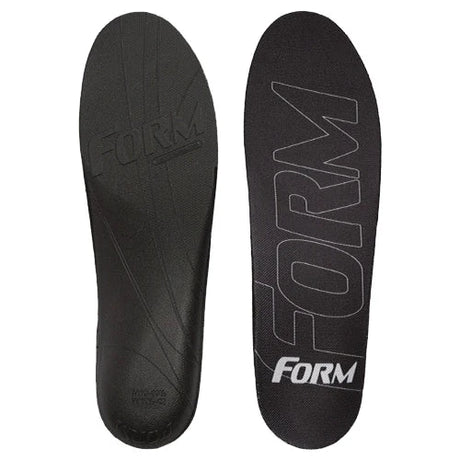

FORM Ultra-Thin Maximum Support Insole


FORM Narrow Maximum Support Insole


Spenco RX Thinsole 3/4-Length Orthotic Arch Supports


Spenco Full-Length Orthotic Arch Supports
Low-arch insoles are designed for feet with a low arch height, where the space between the arch and the ground is reduced and the foot contacts a larger proportion of the ground with each step. Low arches are common and can range from mildly low, with a slightly flattened arch that still provides some midfoot support, to fully flat, where the arch barely rises from the ground at all. Using an arch support that's higher than the foot's resting arch height creates pressure under the arch rather than supporting it. A low-arch insole matches the foot's natural profile, providing contact and support across the full arch zone without the discomfort that a too-high arch creates.
A low-arch insole sits in full contact with a low-arched foot throughout the walking stride, providing genuine support rather than leaving a gap between the arch and the support. This contact is the fundamental requirement for effective arch support: an insole that doesn't touch the arch doesn't support it. For flat-footed and low-arched individuals, a low-arch design is the appropriate starting point before considering whether additional posting or structure is needed.
Low arches are closely associated with overpronation, where the foot rolls inward excessively during the walking stride. A low-arch insole with semi-rigid or rigid structure provides the medial support that prevents the arch from collapsing further under load, limiting the inward roll and keeping the foot in a more neutral position. This reduces the strain on the plantar fascia, Achilles tendon, and the knee and hip structures that bear the rotational consequences of overpronation.
Flat and low-arched feet distribute weight unevenly, concentrating load at the heel and forefoot while reducing midfoot contact. A low-arch insole that fills the arch space and maintains contact with the midfoot improves this distribution, reducing the peak pressure at the heel and forefoot and providing a more even load across the entire bottom of the foot.
Low-arch insoles are typically defined as those with an arch height between 15 and 21mm, measured from the base of the insole to the peak of the arch support. Feet that require this range include mild flat feet and low-arched feet that retain some midfoot curvature. A fully flat foot may fall below this range entirely. The practical test is whether a low-arch insole provides comfortable contact under the arch without creating noticeable pressure. If a low-arch insole still feels too high, a flatter design or an accommodative insole may be more appropriate.
No. A flat insole has no arch structure at all. A low-arch insole has a small but meaningful arch support that corresponds to the slight curvature present in low but not fully flat feet. For truly flat feet, a low-arch insole with additional inner-edge support or a more aggressive supportive structure may be needed. A flat insole provides cushioning but no structural support for the arch zone, while a low-arch insole provides both.
Our team is always happy to lend a hand! If you need any help at all, contact us! We can assist with answering product questions, making a product recommendation, helping to place your order, or providing any other assistance you may need.
There don't appear to be any related articles at the moment, but we update our blog with new content regularly. In the meantime, check out these recent posts!